Google tag

Saturday, 16 May 2015

atbankofdamagain, a blog site of Sekinan Library

atbankofdamagain is a blog site of Sekinan Library from 2013.
There shows the author's life style and hobbies, woodwork and gardening. Also shows some memories dear people met in the life.


The evening of Murayama Dam
 Sayama Hills, west of Tokyo


Dr. Murayama’s Dental Clinic at home town

Dr. Murayama’s Dental Clinic  at home town

                       
Dr.Murayam’s dental clinic was my family’s clinic that was located at the almost centric part of tiny home town. The Doctor was older graduate from my Alma mater. He was tall and always spoke calm and gently.
One day I went to the clinic for treating. After the treatment he said that the old boy’s association would be held at one day of one month.  The day came and I honestly went to the place of the association, where is the home town’s temple which priest was also an old boy of the high school. The attending member at that day was only four. Older three talked each other on all sorts of things. I only heard their conversation because I was young at age 20s and the remains were probably 50s or 60s. The meeting ends by the old day’s graduates reports and so on.
Now I remember that day and really think I happily attended that meeting. All the three members are dead now. I only remains. There are some old boys not attending that day. But Dr. Murayama probably showed me the atmosphere of the tiny association of the group. I sincerely thanked him. He was surely my dental doctor but over this fact he was a respectable old boy with soft gentle voice.
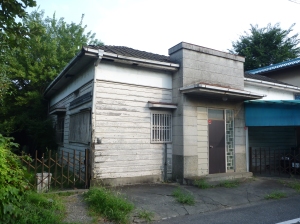
P1000250                                       Remained clinic entrance now not used

A short history of Sekinan's language study

A short history of Sekinan's language study is shown at About 2 of Sekinan Library.
The photo added below is taken at the Kirigamine Highlands, Nagano, Japan, where my early papers from 2003 were often written in the summer at the lodge of the highlands hill side.


From Distance to Pseudo-Kobayashi-Distance, A short history of my study


From Distance to Pseudo-Kobayashi-Distance 

TANAKA Akio


In 2004 I wrote the paper titled "Distance Theory"
The paper handled the structure of sentence, using the classic written Chinese for its simplicity of form that has not any transformation at word.
In Chinese, word namely character does not change any more. Nevertheless grammatical functions strictly exist by its sequence of characters.

I had been very interesting the style of language that never appears in the European languages. But the study for it was too hard to pursue at my age 20s and 30s by my talent.

In 1979, I met CHINO Eiichi again at the university to where I returned from the work of teaching at senior high school. He taught me the importance of the Linguistic Circle of Prague.

We talked with many problems of language study at the campus or coffee shop near the station we usually got on and off . The shop were old and steps were always sounded rattling. The light of the shop were dim and yellowed with age.

We were both young, he was late 40s and I was early 30s.
Before these days we already met at the Russian class. The time was 1969, he taught us the language in the tiny classroom. Then he was just after, coming back from the long study at Czechoslovakia.

From 1979, he had actively introduced the Linguistic Circle of Prague while studying his own subjects. It was a really happy time for me. He told us at the class of linguistics and told me more frankly at the coffee shop on the various themes related with language .Prague was always at the centre in the conversation.

I gradually went on to the narrow theme concerned with language universals.  What decisively entered to my mind was Sergej Karcevskij. If there only be Saussure, I could not determined so smoothly.

In my age 30s, 1980s, I had been wandering to and fro at Kanda, the centric part Tokyo, where I encountered many Chinese classics at the Chinese book shops. From my familiar language I wanted to research the study on the subject. But  there were no clear road to going ahead.  I had hoped concise and clear description on the theme, if I wish, using mathematics.

In 1960s, in my front, Bourbaki emerged the huge target that was built by the vast from-set-theory-to-topology. At the time's going my level was very low and primitive. I was never able to use such a difficult mathematics.

I spent the lag time in 1970s. reading Chinese classic books at random. The main was Qing dynasty's Xiaoxue (Small study) on Chinese characters classical research.

In 1990s, the target of language study decided to language universals, being led by Sergej Karcevskij for that almost all the information were given from CHINO.

At that time mathematics were going on and on to the wide and deep fields covering the humanities, e.g. category, sheaf and discreteness.

In March 2003 I stayed some days at Hakuba, Nagano, where I wrote the proto-paper on language model for the first time, titled " On Time Property Inherent in Characters". It treated the unchanging language, Chinese, as the typical one for its simplicity and familiarity in my life.

The paper's main theme was time that is hypothetically  inherent in each character in Chinese. The basis of the theory was in the study of WANG Guowei's ancient Chinese inscriptions on bone and tortoiseshell.

In order to possess grammar in unchanging language, there should be the another functions to express grammar or near -grammar. I selected inherent time in each character supposedly.

In August 2003, I also stayed at Hakuba, where I wrote "Quantum Theory for Language". It was the enlarged paper of the March's one. There intuitive long-short times were supposed. There was any description of mathematics. But important points were presented, I thought. The problem was how precisely go the theory using mathematics.

In 2004 I wrote " Distance Theory" from the viewpoint of clear concept using distance instead of time that was not able to mention enough descriptively.

But the theory was also intuitive and philosophical one. I never satisfied the expression.  The theory's essentials were distance and connection, that is to say, words connect according by the distance inherent in words.

Succeeding this theory, I tried to write many fields on language making the efficient models for natural language, namely language universals in my mind, being led by Karcevskij.

Hereafter the main target was the mathematical description for many varieties that were almost intuitively remained or noted.

Now I use algebraic or arithmetic one for their strict simplicity and beauty. Recently I wrote in distance from pseudo-Kobayashi-distance that was very fantastic and widely perspective views for me. The paper's title is 'Connection of Words", that is my long winding road from encountering CHINO and Linguistic Circle of Prague.
                                                                    Tokyo
                                                        February 5, 2012
                                     Sekinan Research Field of Language

Friday, 15 May 2015

ONO Shinobu and Bernhard Karlgren

TANAKA Akio

In December 1979, I submitted the post-graduate thesis on Japanese Buddhist priest Kukai (774-835)'s maiden work Sangoshiiki that comparatively considered the three regions, Confucianism, Taoism and Buddhism. Probably in January 1980, I met with Prof. ONO Shinobu at the corridor of university. He said to me that he read my thesis and my thinking method using at the thesis was resembled in the method of Bernhard Karlgren at his paper "The Authenticity and nature of the Tso Chuan" 1926. He succesively talkedto me, "TANAKA, did you read the paper?" I promptly answered " Professor, No."

My thesis was presented the other prof. who specialist of  the old Buddhism in Japan and probably he sent my thesis to his dear fried ONO. My approach was the study on the appearance frequency distribution of all the expletives appeared in the text.

I knew this famous Sweden sinologist's name earlier and already bought one of his important work Grammata Setica Recensa, 1957 in the early 1970s at Kaifu Shoten Book shop in Kanda, Tokyo. But the paper shown by ONO was perfectly unknown at that time. ONO invite me to his study room and handed me the book Saden Shingi Ko" that was the translation of Karlgren's paper  by ONO and published in 1939 from Bunkyudo Shoten Book shop at Hongo, Tokyo, which was one of the leading publisher in the field of Chinese classics in 1930s.

ONO was one of the scholar on Chinese literature from Yuan dynasty to the modern China and the member of Chugoku Bungaku Dokokai, Chinese Literature Society in Japan that led the study of modern Chinese literature in Japan from 1940s. with his colleagues TAKEUCHI Yoshimi, TAKEDA Taijun and the like. In 1980s he had engaged in the translation of long novel, The Journey to the West in the Ming dynasty all the time of his non-university's work.

Going back to the past, I received ONO's lecture " Chinese literature and Modern Japan" at his study room or dean room, who was the dean of the faculty for humanities department. In my memory he lectured precisely to Japanese novelist ODA Takeo, now not famous recently.

Karlgren's book was difficult for my talent at that time but somehow  read over and gave back to ONO deeply appreciating his kindness. And some years later in Kanda, Tokyo, I found this Karlgren's book and bought. The book shop's name is Yamamoto Shoten, one of the long established Chine classic book shop in Kanda.  The date is 2 November 1982 by the receipt put in the book.

One day probably in spring 1980, on the train on the way home, I met ONO and told him on his the new lecture on Yuanqu, Yuan dynasty's poems that was frequently said very difficult for modern readers.
I said to him, "Wonderful lecture for excellent undergraduates." He returned definitely," Very important to study such a hard work for me still now."

ONO Shinobu died suddenly by disease in 18 December 1980, age 74. The conversation at the train was the last hearing of this profound scholar.


Tokyo
3 March 2015
Sekinan Library

Pioneers for language universals from Sekinan Study

  • Boutbaki, Nicolas
The Time of Language, Ode to The Early Bourbaki To Grothendieck
Bourbaki' ELEMENTS DE MATHEMATIUE Troisieme edition, 1964

  • Karlgren, Bernhard
ONO Shinobu and Bernhard Karlgren

  • Karcevskij, Sergej
Meaning Minimum On Roman Jakobson, Sergej Karcevskij and CHINO Eiichi
Half Farewell to the Linguistic Circle of Prague and Sergej Karcevskij
Sergej Karcevskij, Soul of Language
Gift from Sergej Karcevskij
Follower of Sergej Karcevskij
For KARCEVSKIJ Sergej
Notes for KARCEVSKIJ Sergej / Note for KARCEVSKIJ Sergej's "Du dualisme asymetrique du signe linguistique"

  • Jakobson, Roman
Roman Jakobson
From Cell to ManifoldMeaning Minimum On Roman Jakobson, Sergej Karcevskij and CHINO Eiichi

  • Sapir, Edward 
Edward Sapir, Language, 1921
Substantiality

  • Saussure, Ferdinand de
Uniformity For SAUSSURE Ferdinand

  • WANG Guowei
The Time of WANG Guowei
40 years passed from I read WANG Guowei
  • von Neumann
The days of von Neumann Algebra
The days between von Neumann Algebra and Complex Manifold Deformation Theory

  • Wittgenstein, Ludwig
The Time of Wittgenstein
For WITTGENSTEIN Ludwig Revised with Symplectic Language Theory and Floer Homology Language

Tokyo
15 May 2015
Sekinan Study

Papers classified by theme From Sekinan Study

Papers classified by theme


Algebra
Distance
Energy
Language
Library
Linguistic Circle of Prague
Mathematics
Philosophy
Pioneer
Time

Tokyo
15 May 2015