Google tag

Saturday, 4 August 2018

The Time of Quantum 2008

Inspiration   The Time of Quantum

TANAKA Akio

In August  2003, I went to Hakuba in Nagano prefecture for the summer vacation with my family.  At that time I had been thinking on the form of language for which I wrote the paper,  that connects with time inherent in characters, in March 2003 also at Hakuba.

At night of August 23 in cottage, I casually saw the advertising paper of electric dictionary.  The paper was brought from the convenience store near  the cottage in the evening. The dictionary  on the paper was Seiko’s English-Japanese dictionary that has additionally consultation for Chinese or French language with large scale. I vaguely considered that after this dictionaries are necessarily taken these multi-lingual way.

At the time I suddenly  realized that the form of language may be spherical style in which language contains all the information in itself.That was rather satisfied solution for the tough problem of language that I had been carrying in my life from my twenties.

I wrote the sketch-like paper of the theoretical approach after returning home of Tokyo. The paper was read at the international symposium of UNESCO opened in winter 2003 at Nara. In the paper, the spherical substance of language is seemed to be quantum in DELBRUCK’s image-like physical world. After 5 years from the inspiration at summer of Hakuba,  now I consider that spherical essence is manifold in infinite dimensional world.

Now I also realize that the toughest problem of language is minutely solvable in mathematical approach that has structurally definable terms.

Tokyo
September 29, 2008
Sekinan Research Field of Language 

[January 23, 2012]
The title changed.
The former title is “From Quantum to Manifold”.
[Postscript. January 25,2012]
On quantization of Language.
Refer to the next.
Quantization of Language 
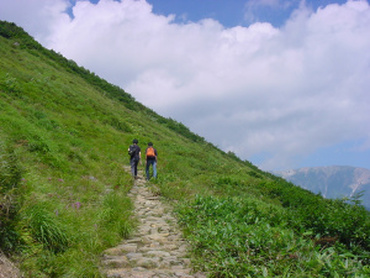
Picture
Climbing to the Happoike Highland Pond, Nagano
Afar seen the Hakuba Range
Photo taken at 24 August 2013

​The Time of Wittgenstein 2012

​The Time of Wittgenstein 

TANAKA Akio
             
                         
There surely exists the time of Wittgenstein for me.
That time about in my age 30s, in the middle of 1970s.
One may aware of the kernel of the problem after almost all the hardships were gone and the problem is going under pursuing in the daily work for oneself, as Wittgenstein wrote at 6.521 in TRACTATUS LOGICO-PHILOSOPHICUS.  

Wittgenstein wrote on language immanently at least in TRACTATUS.
He also said in TRACTATUS 6.432 that how world exists  does not care from the higher dimensions.
I also wanted to write on language from the immanent side in language.
But I had not any pursuing method for writing on language at that time, only remaining set theory typically presented by Bourbaki that some translations were surely on my desk.

Set theory was enough fascinating at the time, but it did not give me any relative and constructive situations on language or widely on the world. It was isolated and non-relative for writing on language. I wanted the bond of the world. 

Now I have geometry for which the world can be bonded enough tightly. In 1970s I was never aware of the existence of geometry by myself, probably not being influenced from Wittgenstein's 6.35 in TRACTATUSGeometry absolutely tell nothing on how the figure is and where the figure situated.

So I had remain silently in the days not being able to write on the theme, the basic essence of language. Then I never knew the object on language, language universals that was taught from CHINO Eiichi later in 1980s. CHINO showed me the paper of Sergej Karcevskij, Du dualisme asymétrique du  singe linguistique. The theme determined my remain life hereafter. CHINO was the true teacher of my study. 

Wittgenstein wrote at the last 6.54 of TRACTATUS that his some propositions must be abandoned. I began to go through the wood of hard theme of language universals by mathematics especially using geometry. About what can be told to, I never must be silent. 

Reference
Citation from Ludwig Wittgenstein


Tokyo
January 20, 2012
Sekinan Research Field of Language

The Time of WANG Guowei 2011

The Time of WANG Guowei

TANAKA Akio

I learned the language study from CHINO Eiichi at Tokyo in 1970s.
He taught me the Llinguistic Circle of Prague and the existance of KARCEVSKIJ Sergej.
One day he admonished me not to study the hard problems such as language unversals that are the themes worked on by the geniuses like WITTGENSTEIN Ludwig.
But I chose the theme probably by my youth.

For long time I kept thinking on language universals being aided from KARCEVSKIJ’s paper, “Dusualisme asymétrique du signe linguistique“.
I roamed the vast field of language wondering the streets of Tokyo.
The time passed.
CHINOI suddunly died by the fatal disease in 2002.

I wrote the original note on language universals at Hakuba, Nagano in March 2003.
The note were fundamental but conceptive.
The title was ” On Time Property Inherent in Characters“.
It was written on the written language of ancient Chinese characters inscribed on tortoise shells.
WANG Guowei was the pioneer scholar on that field.

I had liked his papers that were almost contained in his most important work, “Guantangjilin”.
I bought the book Kanda, Tokyo in the earky 1970s.
The bookshop name was “Haifeng Shudian”, that are now removed to Chiba Prefecture.
Oh how many times I went to the shop and bought the Chinese classics.
Qing Dynasty produced the linguistic scholars who almost all researched the Chinese characters for their scholastic basis.

I also liked ZHANG Binglin, DUAN Yucai, WANG Niansun, WANG Yinzhi and so on.
In my first note I quoted WANG Guowei and DUAN Yucai.
They are the precursors of the study of language universals for the prime of life.
The study was traditionally called “Small study” in China.
But I coud not remain standing in the conceptive place influenced from Small study.

The second note was “Quantum Theory for Language“, that were also written at Hakuba in August 2003.

The third note was “Distance Theory“.
In the early stage of my research, “distance” was one of the important concepts for language unversals.
The concept was inevitably related with time and space.
So I began to think the themes on Language universals based on mathematics that were another prime time theme of my youth.

Tokyo
20 December 2011
Sekinan Research Field of Language

The Time of Language 2012

The Time of Language
Ode to The Early Bourbaki To Grothendieck


TANAKA Akio 

In early 1970s, I had think of language from the side of mathematics, that level of mine is very low and primitive, moreover I never had any talent to mathematics.
But my eager to trying the approach was going to overcome hard barriers before me. So the route had really fascinated my mind for long time.

At that time I had read Chinese classics almost every day. WANG Guowei*, DUAN Yucai and WANG Yingzhi. They were giants on Chinese language historically and modernly.
On the other hand I had thought of language generally, not defined by Chinese.
But in front of the vast world of language, I had stood still lonely, not taking any method for approaching.
Mathematics was the only gleam of hope in the wasteland.

I never took the route of ordinary linguistics.
I really dreamt a dream that time.
There exists set theory before me.
Probably there was the influence of Bourbaki**, that several translations to Japanese, shared from Tokyo Tosho Publisher, were on the desk of mine.
My talent and endeavour were so low, so I had not any results at that time.
My desire was deep but my hand was so shallow.
The time passed by.

In 1979 the meeting again with CHINO Eiichi*** made me the chance to learn on language, the object was clear and direct.
Language universals by mathematics became the never-ending goal of the study hereafter.
Sergej Karcevskij**** gave me the courage to the research.
All the way to investigation were taught from CHINO, who was the genuine teacher on language.
In mathematics I took the route from geometry, especially by projection.
Now I stand at algebraic geometry.
Grothendieck is in the northernmost at the end of Bourbaki.

SAITO Takeshi said at the essay on Grothendieck***** that the object of mathematics for Bourbaki was the set of being attached by construction and the object of mathematics for Grothendieck was the object of category representing the presentable functor.
The time has come for describing****** on language by mathematics despite my poor ability.
Sincere thanks for the pioneers letting us make the fascinating route of modern mathematics.

1. *WANG Guowei
Encounter in life / A Letter /2005
Influenced paper / On Time Property Inherent in Characters / 2003 , Quantum Theory for Language / 2004
2. **Bourbaki
SAITO Takeshi. Bourbaki, Mathematics Seminar, vol..41 no..4 487. Nihonhyoronsha, Tokyo, 2002.
3.***CHINO Eiicji
First met in 1969, again in 1979. Fortuitous Meeting
4. ****Sergej Karcevskij
Note on Karcevskij's theme. Note for KARCEVSKIJ Sergej's "Dudualisme asymetrique du signe linguistique"
5. *****Grothendieck
SAITO Takeshi. Grothendieck, Mathematics Seminar, vol..49 no..5 584. Nihonhyoronsha, Tokyo, 2010.
6. ******describing
Note on Grothendieck's theorem. Vector Bundle Model

Tokyo
January 10, 2012
Sekinan Research Field of Language


[Note, 28 October 2014]
When I first learnt French in 1964, I was the second grade of high school. My aim to learning was to get the lowest readable situation for modern poems of French Symbolism represented by Arthur Rimbaud and Paul Verlaine. Afterwards in 1969 I knew the importance of Martinet's work at the linguistic class of university. Probably in the early 1970s, I bought Bourbaki's books at the old-book-shop at Kanda, Tokyo, when Bourbaki's fame reached to the poor-talented linguistic student like me. I was enchanted Bourbaki's works and I somehow would like to adopt their results to my linguistic study. But my mathematical level was too low to get near Bourbaki's world. From those days my wandering around mathematics and linguistics kept long long way like the Beatles song, The long and winding road. What I again met mathematics, especially algebraic algebra was already over the twentieth century. From 2003 I began to write papers being assisted with CHINO Eiichi's advice and Sergej Karcevskij's work. At that times Chinese Qing dynasty's vast linguistic works topically represented by WANG Guowei was also assisting my study. At the result my first satisfied paper,"On Time Property Inherent in Characters"1 was completed. The theme in my life, model making of  language universals was begun further later in 2008 at Zoho site sekinanlogos 3. At Complex Manifold Deformation Theory 4 I started writing more clearer descriptive papers by mathematics especially according to algebraic geometry. And now I step up one more and entered in arithmetic geometry 5 for solving more difficult themes such as dimension, synthesis and fusion of meaning in word.
Refer to the next.

  1. On Time Property Inherent in Characters
  2. Zoho site
  3. sekinanlogos
  4. Complex Manifold Deformation Theory
  5. Arithmetic geometry


Read more: http://srflnote.webnode.com/the-time-of-language/

The Days and the Time 2018

The Days and the Time
  1. The Time of Language
  2. The Time of WANG Guowei 
  3. The Time of Wittgenstein 
  4. The Time of Quantum
  5. The Days of Distance
  6. The days when I was thinking on Energy Distance Theory
  7. The Days of Decipherment
  8. The days of von Neumann Algebra
  9. The days between von Neumann Algebra and Complex Manifold Deformation Theory
  10. Language between Sergej Karcevskij and string theory, one century's trace
 
Tokyo
2 June 2018 Arranged
SRFL Collection


Read more: https://srfl-collection.webnode.com/news/the-days-and-the-time/

Friday, 3 August 2018

History of SRFL 2015

History of SRFL

History of SRFL
  • SRFL started originally as a study library named Sekinan Library at Tachikawa, Tokyo in 1986 .From that time on,  several sites have been made  for the various research activity, In learning days of 1970s, Kurt Godel and Nicolas Bourbaki were strong admiration of keeping the study. 
  • In 1980s, the heart of activity was study of Chinese ancient hieroglph influenced by the Qing Dynasty's scholar WANG Guowei. But last time of 80s, research turned to the basic factors of language, gradually putting language universals in shape.
     
  • In 1990s, Great turn came to th study. Linguistic Circle of Prague in 1920s and its member Sergej Karcevskij definitely opened the direction for the vast and ambiguous approach to the study of language universals. All the hints were given from CHINO Eiichi who had studied on the Slavs at Carrel University between 1958 and 1967. I first met him at his Russian class in 1969. He was 37 and I was 21.
     
  • Since 2000s language universals has became the core theme of study using and arrangring the contemporary resuls of mathematics, esdpetially algebraic geometry that sufficiently reflects the intuitive and concrete images of thinking on complexed language's phenomena. In 2008 Zoho site sekinanlogos was started up for mathematical expression. 
 
Tokyo
17 August 2015


Read more: https://srfl-lab.webnode.com/news/history-of-srfl/

I need not more wander the bookshop streets 2012-2014

I need not more wander the bookshop streets

I need not more wander the bookshop streets

From Print 2012, Chapter 10

I need not more wander the book shop streets. The object exists in my mind. I would better watch the canal. Wandering is over now.  Perhaps I would not become meister  forever. In my narrow working place, I 'd better do my work till sunset. So out of the window by the working place,  the saint passes by. I ever read the Russian folk tale like that.
The Autumn evening is fast. The headlight of streetcar  is dazzling. In the yellow-lighten window the passengers are picked out by the light. The car disappeared  to the bookshop streets. The station shop is also lighted up by the yard's busy orange light.

Read more: https://srflnote.webnode.com/news/i-need-not-more-wander-the-book-shop-streets-from-tale-print-2012/

[Reference]
  1. 40 years passed from I read WANG Guowei / 16 November 2013
  2. Prague in 1920s, The Linguistic Circle of Prague and Sergej Karcevskij's paper "Du dualisme asymetrique du signe linguistique" / Print, 2012

[Note  1 October 2014]
"I need not more wander the book shop streets." 
From Tale, Print, 2012
This tale was written by TANAKA Akio, pen-named LI Koh in autumn 2012 for remembering the poor but brilliant youth time of myself. This is one of my favourite phrases in this tale.

The book shop streets described in the tale is Kanda, Tokyo, which is located in the central Tokyo, where I frequently walked seeking the old Chinese classic books for the study from Oriental way of linguistics. In late 1960s, the streetcars were surely running in the old fashioned streets of Kanda, now perfectly changed to the subway streets. 


Read more: https://srflnote.webnode.com/products/i-need-not-more-wander-the-bookshop-streets1/